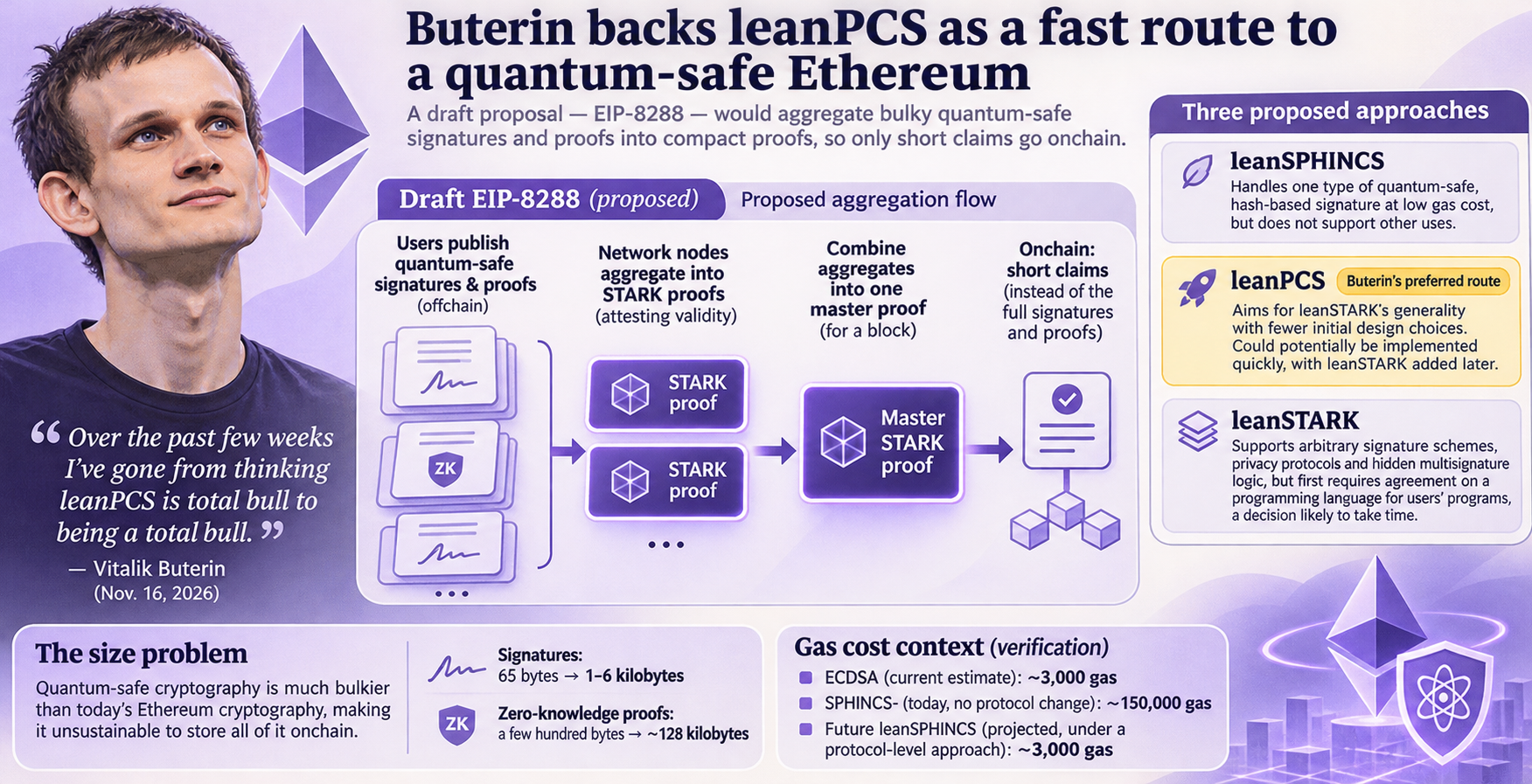
In a November 16, 2026 explanation, Ethereum co-founder Vitalik Buterin said he had become a strong supporter of leanPCS, a proposed approach to handling quantum-resistant cryptography on Ethereum. His argument concerned a possible route to implementation—not an activated network upgrade.
The size problem
Quantum computers are expected eventually to threaten the elliptic-curve cryptography used by Ethereum accounts. Buterin said potential quantum-safe replacements would be substantially larger: signatures could grow from 65 bytes to between 1 and 6 kilobytes, while zero-knowledge proofs could grow from a few hundred bytes to around 128 kilobytes. Storing all of that material onchain would be unsustainable, he argued.
Buterin pointed to draft EIP-8288, which he co-authored with developer Thomas Coratger in June. Its proposed aggregation process would let users publish signatures or proofs while network nodes combine them into STARK proofs attesting to their validity. Those proofs could be combined again into a single proof for a block, leaving short claims onchain instead of the full signatures and proofs.
Three proposed approaches
Buterin described three ways to build the system:
- leanSPHINCS would handle one type of quantum-safe, hash-based signature at low gas cost, but would not support other uses.
- leanSTARK would support arbitrary signature schemes, privacy protocols and hidden multisignature logic. Buterin said it would first require agreement on a programming language for users’ programs, a decision likely to take time.
- leanPCS, his preferred near-term route, aims for leanSTARK’s generality with fewer initial design choices. Buterin said it could potentially be implemented quickly, with leanSTARK added later.
As a separate indication of what is possible without a protocol change, Buterin linked to research on SPHINCS-, a hash-based signature family optimized for Ethereum. That work reported verification of a standards-aligned quantum-safe signature at about 150,000 gas on Ethereum. An earlier Buterin estimate put an ECDSA signature at about 3,000 gas; the research post estimated that a future protocol-level leanSPHINCS approach could also cost about 3,000 gas per verification. Those future costs and capabilities remain projections, not deployed features.