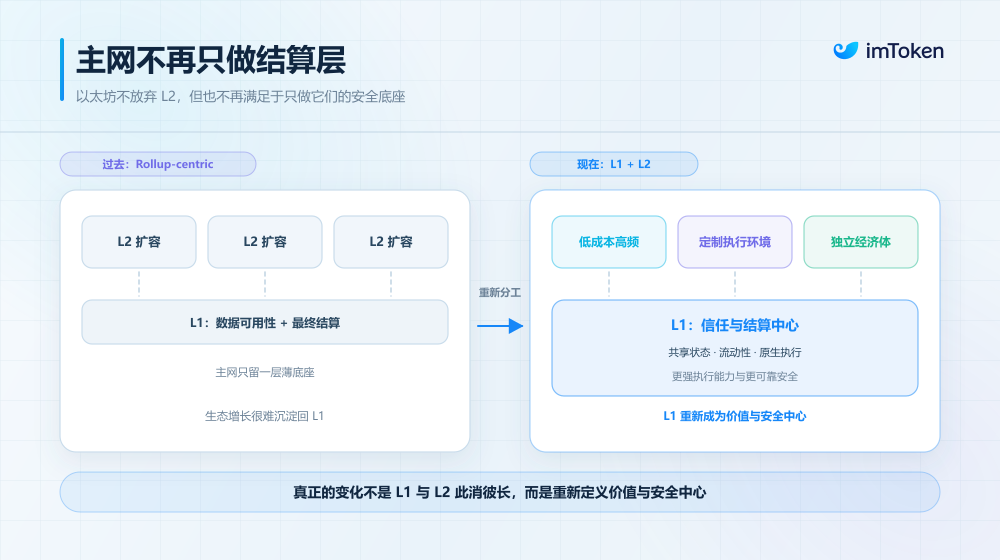
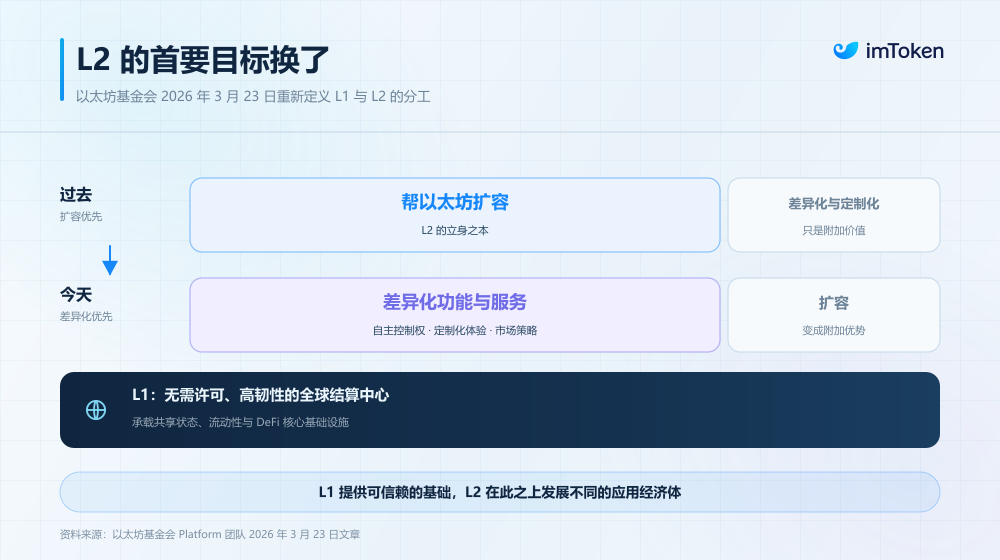
Originally reported by imToken in an article published November 11, 2026, at 21:36 (UTC+8). The article describes a shift in how some projects weigh an independent layer 2 (L2) against deploying on Ethereum’s mainnet, or layer 1 (L1). It does not suggest that L2s are disappearing: the question is which execution environment an application needs, and what it costs to operate one.
Projects reassess the trade-off
ENS Labs planned a dedicated ZK rollup called Namechain for ENSv2 in 2024. In February 2026, ENS co-founder Nick Johnson said the team would stop developing Namechain and deploy ENSv2 on L1 instead, citing mainnet scaling that had exceeded expectations. According to ENS Labs figures cited in the article, the average gas cost of an ENS registration had fallen by about 99% over the preceding year, from nearly $5 to less than $0.05. The article also points to the costs of running an L2 and handling bridging, cross-chain resolution and security reviews.
Synthetix made a different architectural choice. After criticizing liquidity fragmentation and infrastructure instability in a June 2025 post, it launched a new perpetuals exchange on Ethereum L1 that December. As described by imToken, L1 contracts hold user assets, an off-chain central limit order book matches orders, and batches of results settle on mainnet. That arrangement retains dependencies on the off-chain system; it does not make every part of trading trustless.
The article lists other changes in 2026: Trueo announced a move of its primary deployment from Base to L1 in September; ShapeShift moved its rFOX staking program from Arbitrum to L1 on October 1; Superseed stopped its L2 in August and planned to move core products to mainnet; and Nillion began moving Blacklight node operations from its L2 to Ethereum L1 in October. These are distinct decisions, not evidence that every application should leave L2.
Operating a network is also a separate economic question. According to the article, Blast announced on October 2 that it would wind down because network costs exceeded L2 revenue, while Abstract announced a planned December 15 closure. Those cases concern the viability of particular networks, not an Ethereum protocol change.
What remains research, not an upgrade
The article contrasts faster L1 scaling with slower-than-expected progress toward Stage 2 decentralization among L2s. It says that, as of November 2026, only a single-digit number of networks tracked by ETHBEAT had reached Stage 2, while Base, Arbitrum One and OP Mainnet remained at Stage 1. These labels describe L2 properties; they are not Ethereum upgrade stages.
It also discusses native rollups—a research direction in which Ethereum would verify rollup EVM execution using a native ZK-EVM mechanism—and Ethereum Economic Zone proposals for closer interaction between L1 and rollups. Neither is presented as an activated mainnet feature. L2s may still suit applications needing high-frequency execution, privacy computation or greater control over their execution environment.
Fees, staking and ETH’s role
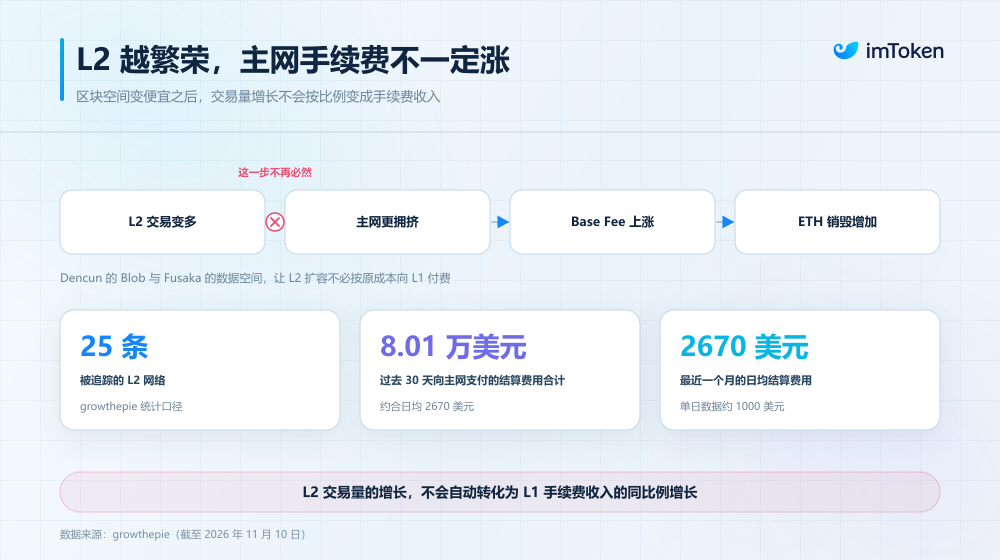
The article then asks whether cheaper transactions weaken a fee-burn account of ETH’s value. Under EIP-1559, the base fee is burned and the priority fee goes to validators. Lower costs for L2 data publication and higher L1 gas limits could reduce fees per transaction; more activity therefore does not necessarily mean proportionately more ETH burned.
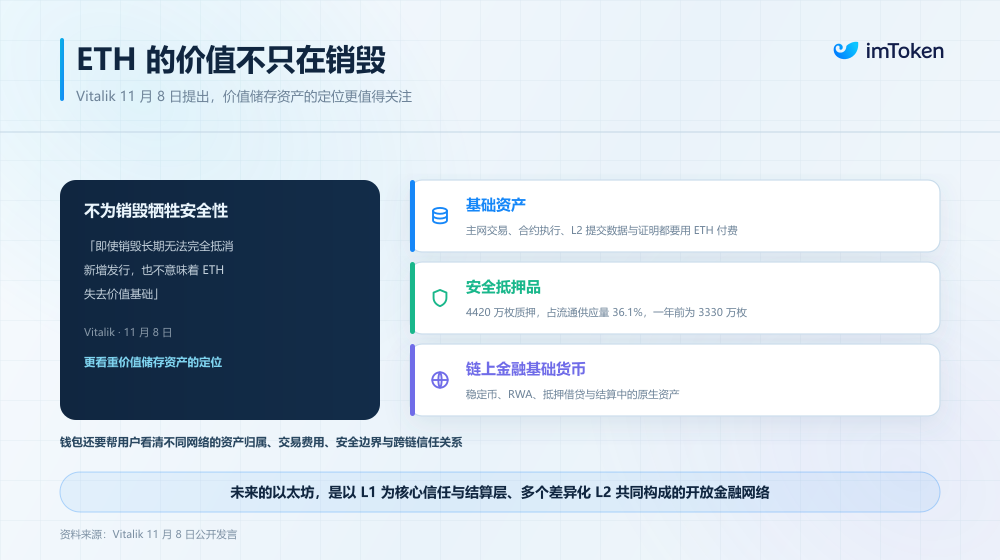
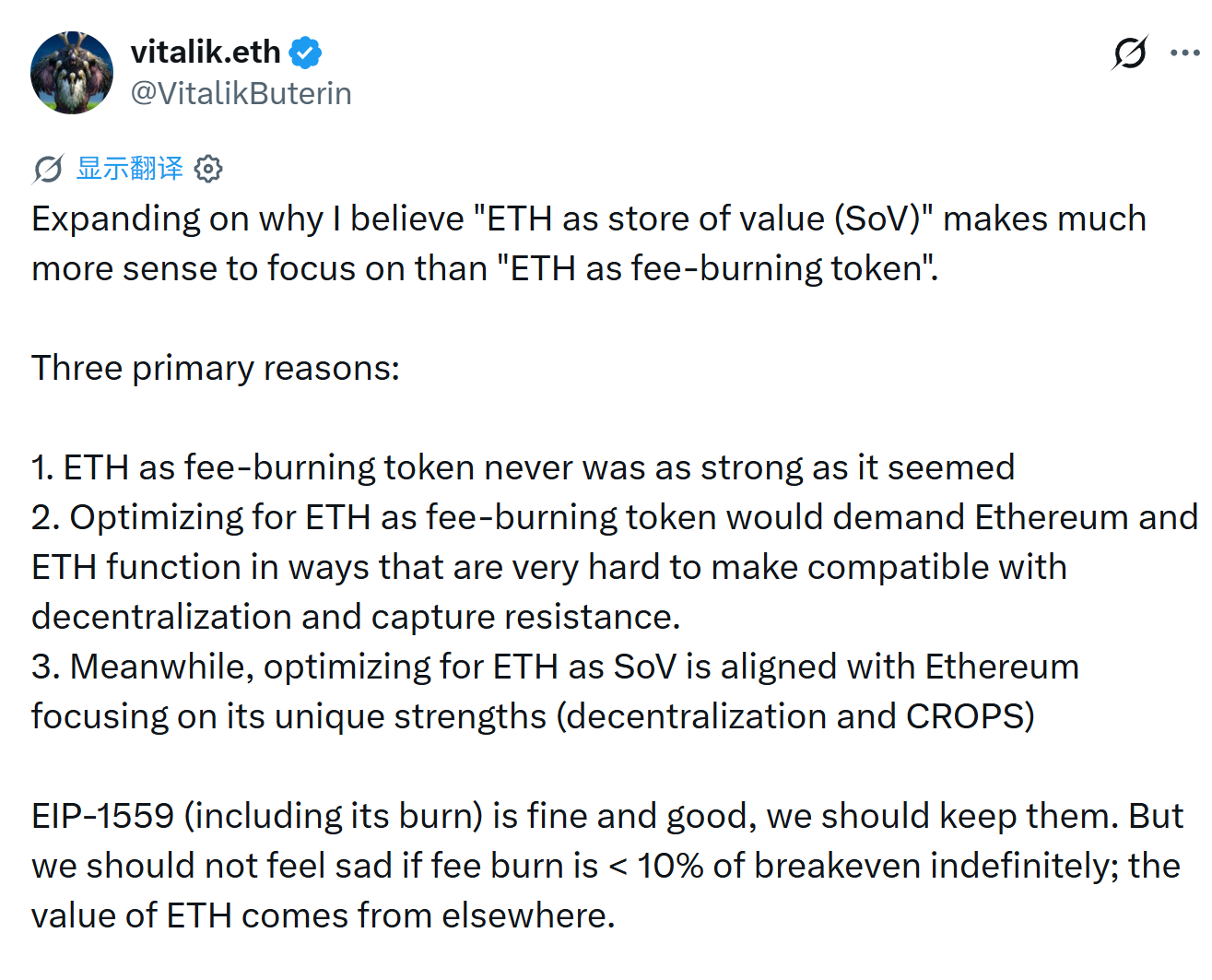
As represented in the article, Vitalik Buterin argues that ETH’s long-term role should not be judged chiefly by burn figures. He does not propose removing EIP-1559. The article instead emphasizes ETH’s uses as the network’s gas asset, proof-of-stake collateral and an asset used in on-chain finance, alongside Ethereum’s decentralization, resistance to censorship and capture, openness, privacy and security. Those are arguments about value and network design, not a forecast of ETH’s price.
Source: panewslab.com (originally published 2026-11-11 21:36 UTC+8)