In an analysis published on November 19, 2026, imToken examined a question behind Ethereum’s post-quantum planning: if today’s signature schemes eventually become vulnerable, how can users retain control of their existing accounts and assets while moving to new cryptography?
The analysis described December 2029 as an engineering target, not a scheduled activation. It said the Ethereum Foundation’s protocol priorities, published in September 2026, aimed to make L1’s execution, consensus and data layers resistant to quantum attacks by then. The proposals and research directions discussed below are not deployed changes.
What would need to change?
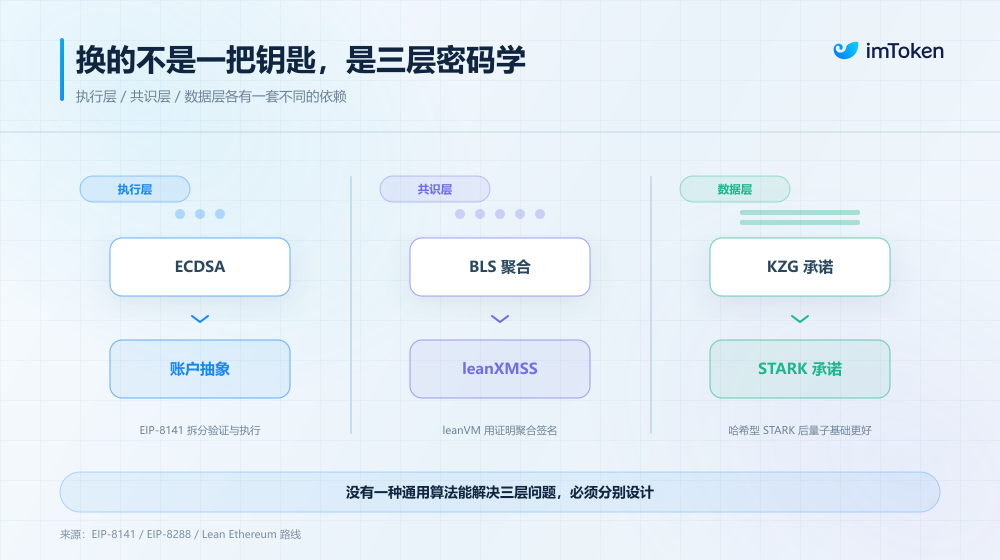
Ethereum uses different cryptographic tools for different jobs. Ordinary externally owned accounts (EOAs) use ECDSA signatures to authorize transactions; proof-of-stake validators use BLS signatures for votes that can be aggregated efficiently. KZG commitments support blob data availability, while some rollup proof systems rely on cryptographic assumptions that also warrant review.
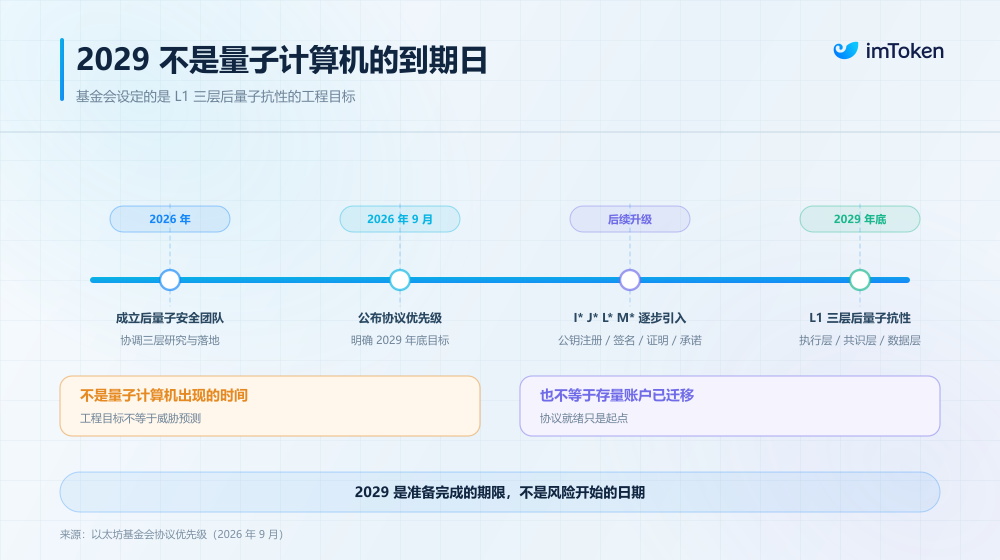
A sufficiently capable fault-tolerant quantum computer running Shor’s algorithm could, in theory, undermine the elliptic-curve assumptions behind ECDSA and BLS. imToken noted that no quantum computer capable of breaking these systems existed at the time of its November 2026 analysis. Hash functions such as Keccak-256 face a different, less direct quantum risk.
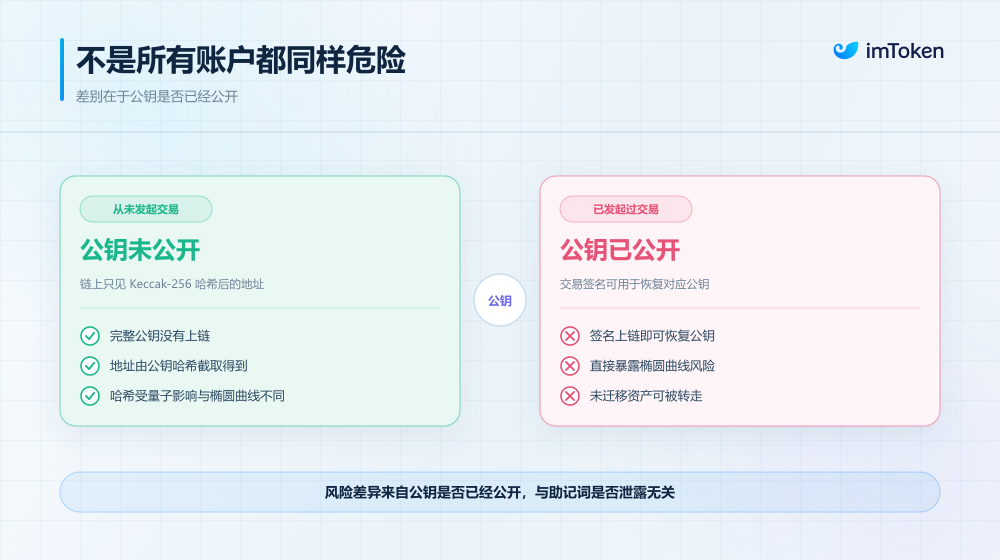
That distinction matters for EOAs. An address is derived from a hash of its public key. According to imToken, an account that has never sent a transaction or disclosed an off-chain signature has not exposed its full public key in the same way as an account whose transaction signature is public. Once a transaction is signed and published, its signature can reveal the public key, creating a potential exposure if elliptic-curve cryptography is broken in the future. This is a long-term threat model, not a reason for users to rush to move assets now.
The proposed work spans three layers
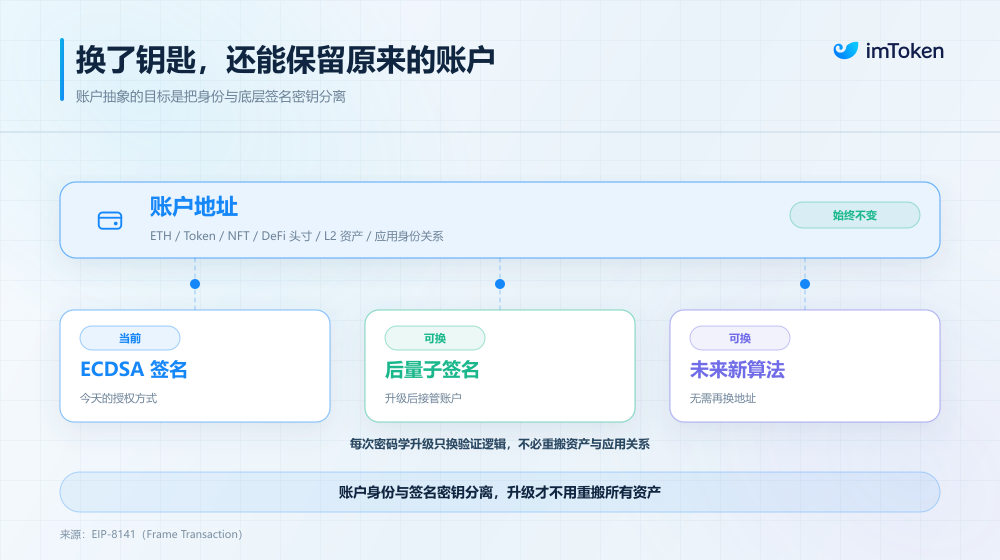
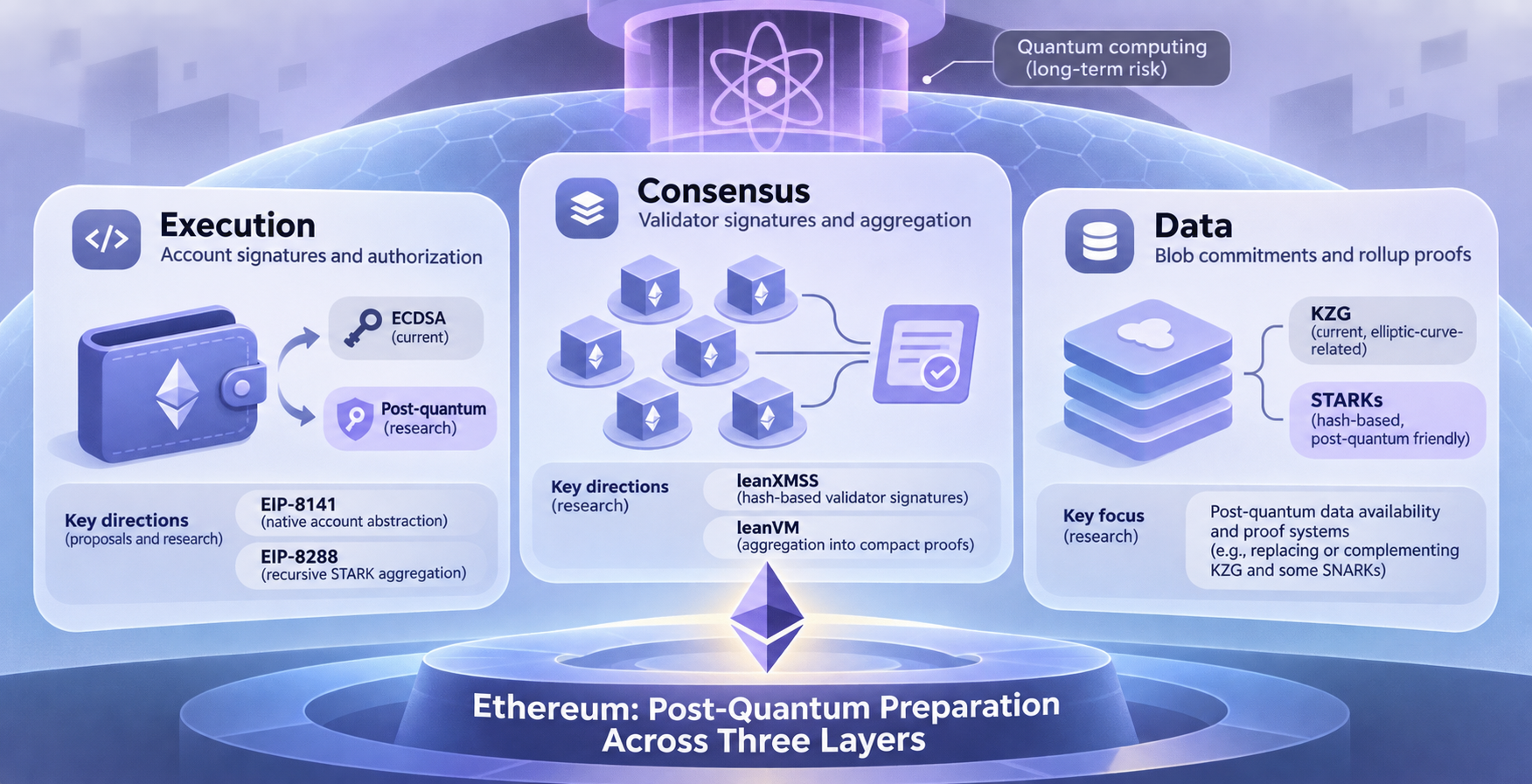
Execution and accounts. imToken highlighted proposed native account abstraction under EIP-8141. By separating transaction validation, execution and gas payment, the proposal seeks to give accounts more flexible authorization rules, including a path toward changing keys or signature schemes without necessarily changing the account address. The analysis also discussed research into precompiles for verifying post-quantum signatures. EIP-8288, another proposal it cited, would use recursive STARK aggregation to reduce the on-chain verification and data burden associated with larger post-quantum signatures. Neither proposal should be mistaken for an activated account upgrade.
Consensus. Replacing validators’ aggregatable BLS signatures with larger post-quantum signatures could raise network propagation, storage and verification costs. The Lean Ethereum directions described by imToken include leanXMSS, a hash-based signature scheme proposed for validators, and leanVM, an approach to aggregating many such signatures into compact proofs. These are approaches under development, not a completed validator migration.
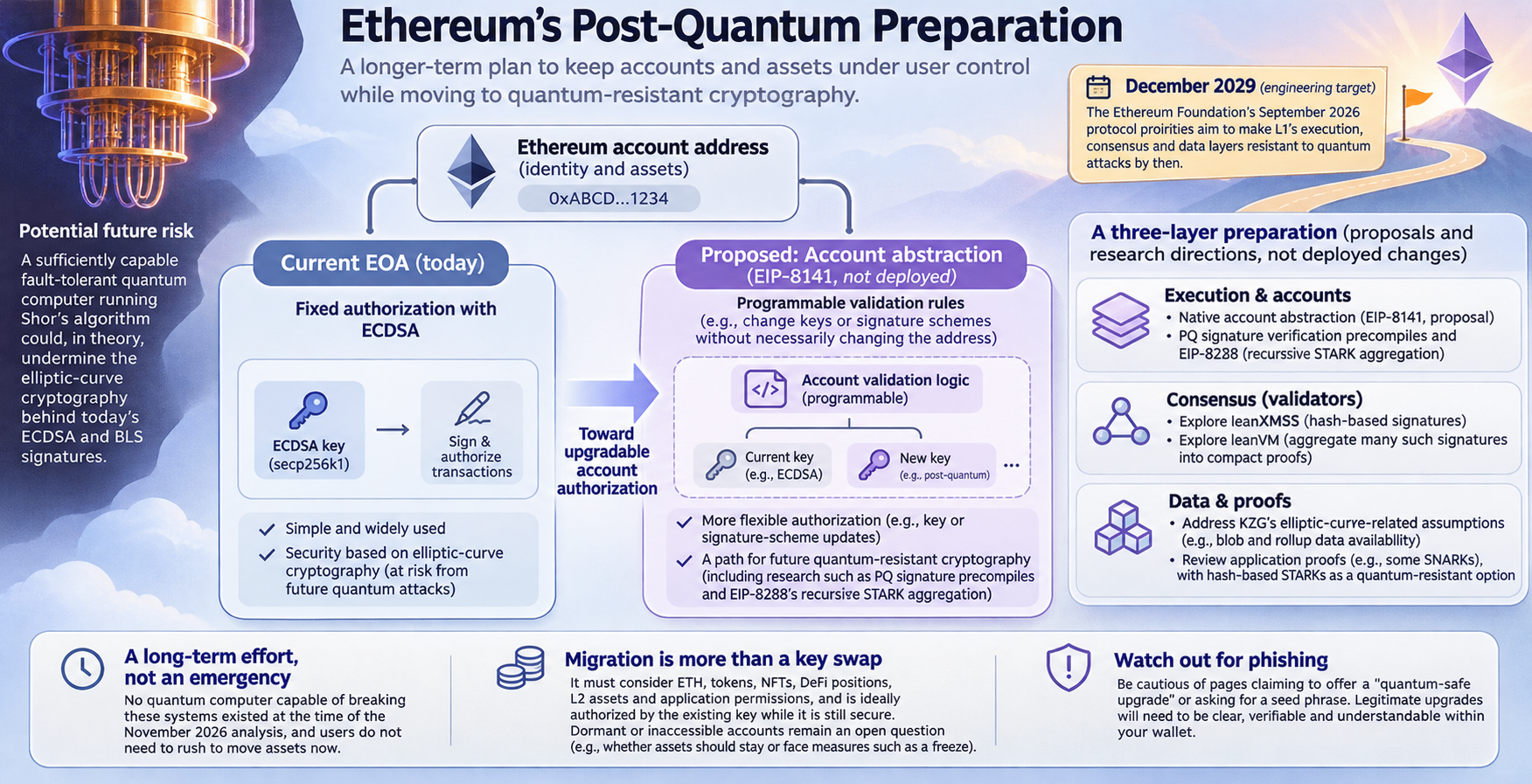
Data and proofs. KZG commitments depend on elliptic-curve-related assumptions, so a post-quantum transition must also address blob and rollup data availability. Some pairing-based SNARKs used by applications may face similar concerns. Hash-based STARKs avoid the same elliptic-curve discrete-log assumption, though changing proof systems across L2s and applications would be a separate undertaking.
Migration is more than a key swap
For a conventional EOA, adopting a different signature system may mean adopting a new account address. That can complicate control of ETH, tokens, NFTs, DeFi positions and assets on L2 networks, as well as application permissions tied to the old address. Programmable account validation could offer a way to change authorization while preserving an account’s identity, but the capability described in EIP-8141 remains a proposal.
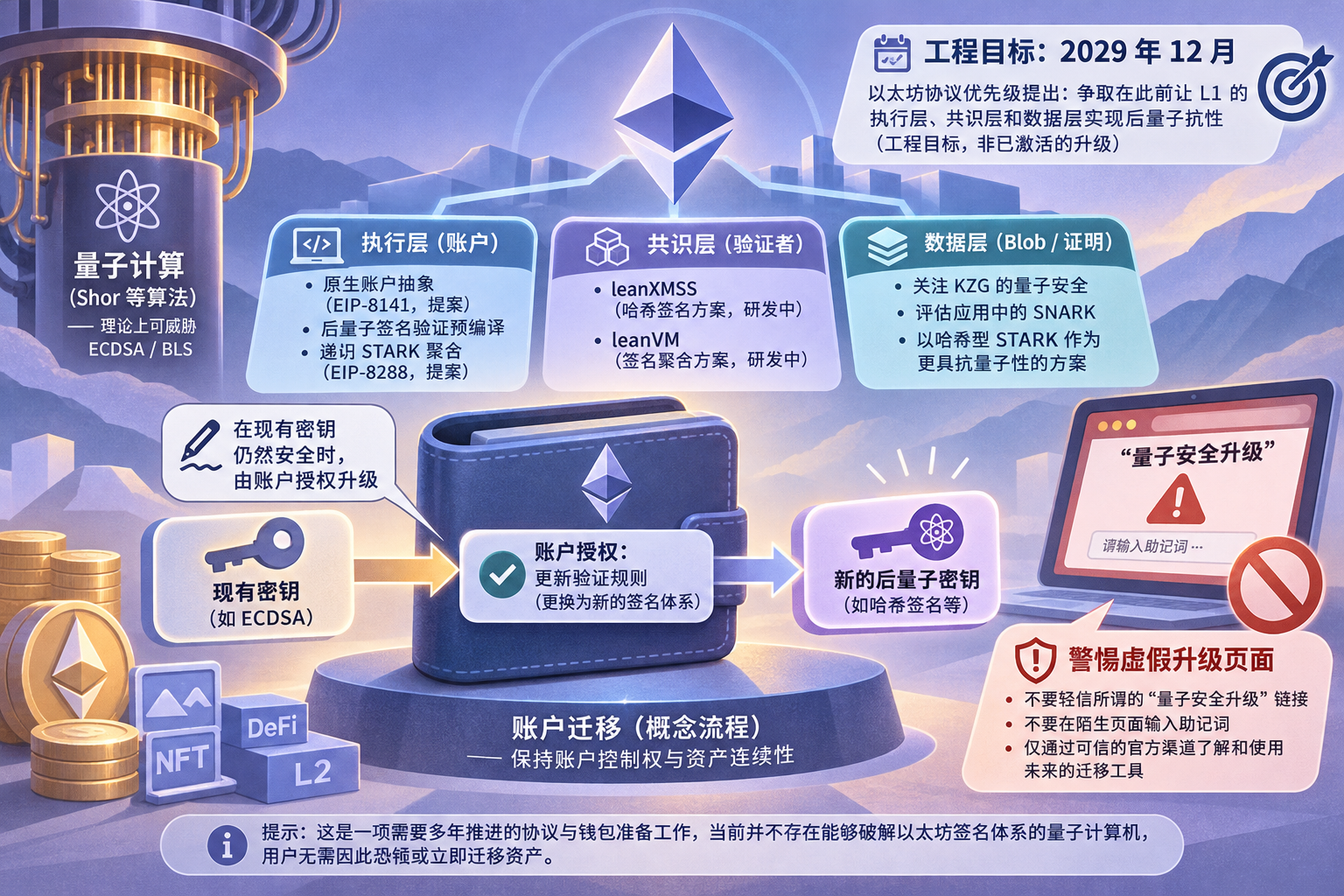
Timing also matters. imToken described an ideal migration as one authorized by the existing key while that key is still secure. If attackers could already forge signatures from exposed public keys, an old-key signature alone might no longer establish who legitimately controls an account. The analysis left open the harder question of dormant or inaccessible accounts: whether assets should remain at their old addresses or face measures such as a freeze is disputed, not an adopted rule.
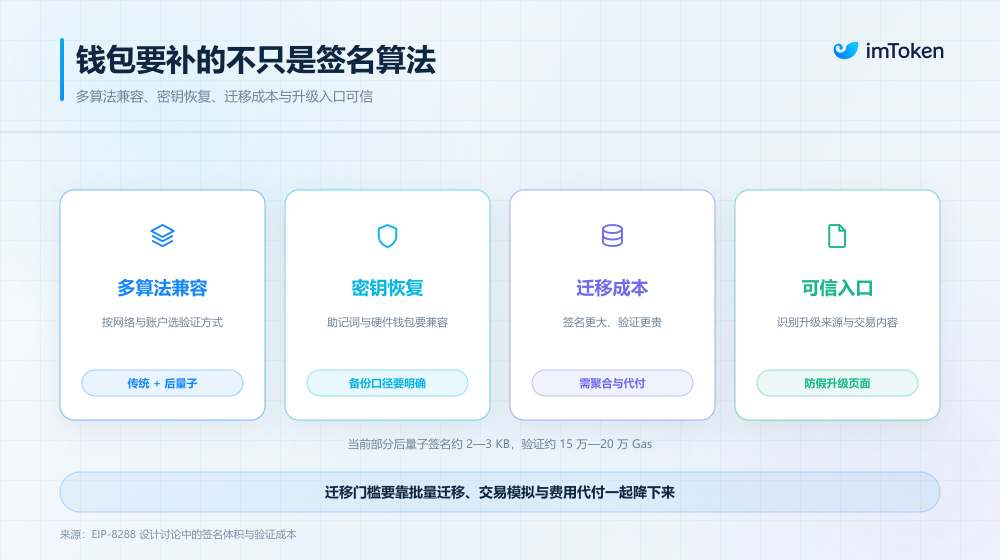
Any eventual wallet migration would need to make authorization changes understandable without creating an opening for phishing. Pages claiming to offer a “quantum-safe upgrade” or asking for a seed phrase would not, by themselves, establish that an upgrade is legitimate. The immediate work described in the analysis is preparation across protocols and wallets—not an emergency instruction for users to migrate.