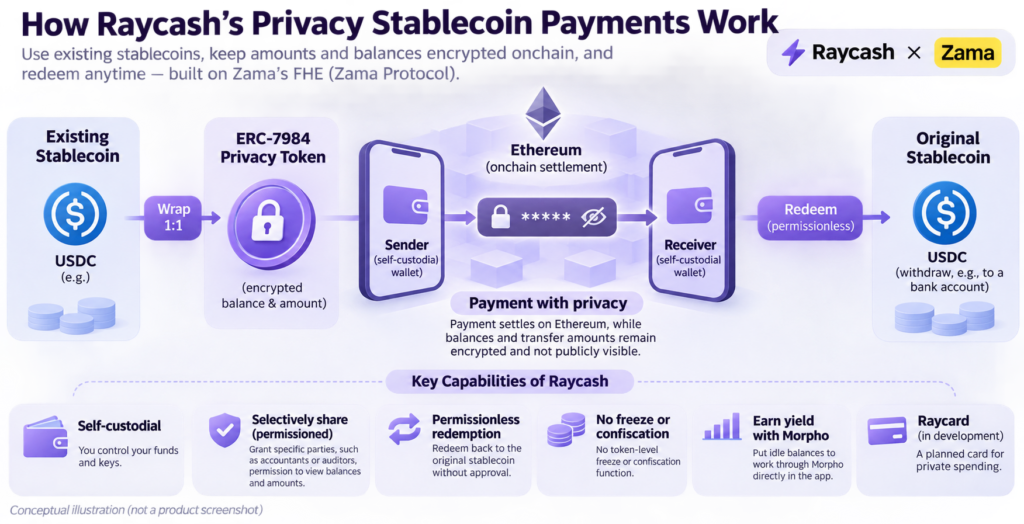
Raycash, a stablecoin payments company spun out of fully homomorphic encryption (FHE) protocol Zama, had launched on Ethereum mainnet as an invite-only beta by November 9, 2026, according to The Block, as reported by TechFlow that day. Its waitlist exceeded 75,000 people. The report described Raycash as the first retail payments product built on Zama Protocol.
How the payments work
Users can wrap existing stablecoins 1:1 into ERC-7984 privacy tokens. Payments still settle onchain, while balances and transfer amounts remain encrypted rather than publicly visible. Users can grant selected parties, such as accountants or auditors, permission to view that information.
The reported design uses self-custodial wallets, allows permissionless redemption and has no token-level freeze or confiscation function. At launch, Raycash supported USDC, with other stablecoins planned. Users could add funds by bank transfer, card or stablecoin, withdraw to a bank account, and send or receive payments through links. Network fees were handled in the background, so users did not need to hold ETH.
Raycash also allowed users to put idle balances to work through Morpho within the app and was developing Raycard for private spending.
Zama’s earlier privacy products
Zama launched a private USDC yield vault with Morpho and Steakhouse Financial in June 2026. According to the report, its locked assets grew from zero to $40 million in seven weeks. On September 15, Zama expanded to 16 private vaults and launched private swaps on Ethereum.
Raycash CEO and co-founder Valerio Leo said users should not have to choose between stablecoin convenience and keeping their financial information private. He described the approach as making dollars people already use private, without asking them to trust a new stablecoin and while preserving an exit.