As reported on November 10, 2026, Ethereum’s quantum-resistance roadmap was a sequence of proposals and research milestones—not a set of activated upgrades.
At Devcon 8 in Mumbai, Ethereum Foundation researcher Justin Drake said he hoped Ethereum could complete a quantum-resistant and “post-AI” transition by December 2028. That is more aggressive than the Foundation’s published plan, which set December 2029 for three layers of quantum resistance and said the date would remain unchanged until a review with external experts in January 2027. Drake’s goal would require three hard forks in the 24 months after Glamsterdam.
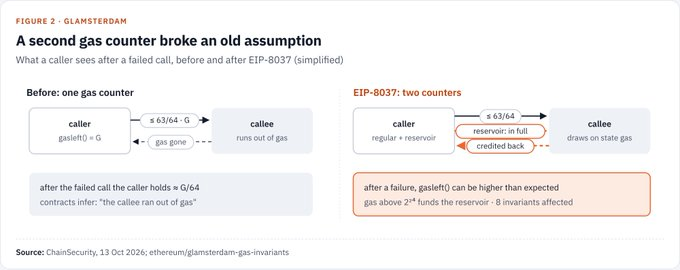
The immediate obstacle is upgrade delivery. Glamsterdam was removed from its second testnet on October 22 after a proposed gas repricing exposed assumptions relied on by deployed contracts. The Foundation subsequently described eight affected invariants, while an AllCoreDevs summary counted 13 affected DeFi projects. The Hoodi testnet was postponed without a replacement date; All Core Devs coordinator Nixo wrote that the setback would “very likely” push Glamsterdam’s mainnet release into 2027. That was an assessment, not an announced activation date.
A roadmap measured in forks
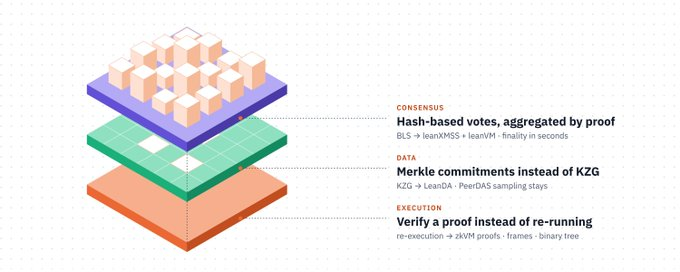
The Foundation’s draft roadmap uses Hegotá and then the placeholders I*, J*, K* and L* to describe successive upgrades. Hegotá, envisaged for 2027, is not itself the quantum-resistant fork. Its proposed frame transactions would let accounts specify their own authorization methods, creating a route away from ECDSA without requiring a new fork for every signature scheme. I* would introduce leanVM and quantum-resistant “lean” transactions. J* would add hash-based validator signatures and quantum-resistant data sampling—the Foundation’s “minimum viable quantum-resistant” milestone. K* and L* would bring mandatory execution proofs and the remaining Lean architecture changes.
Three forks in 24 months means an average of one every eight months. The source contrasted that pace with recent Ethereum fork intervals of 11, 14 and seven months. Its central scheduling question is therefore whether the proposed components can be reviewed and deployed at that rate without breaking existing behavior.
Glamsterdam illustrates the compatibility problem. Under the proposed EIP-8037 repricing, writing a new storage slot would rise from 22,100 to 110,020 gas, and deploying a 24 kB contract would cost roughly eight times as much. ChainSecurity warned that the accompanying handling of state-gas costs could allow some error handlers that previously ran out of gas to complete, bypassing checks used against malicious interference. EIP-8037 was under review, not an enacted mainnet rule. The dependency matters because the Hegotá frame-transaction plan lists that repricing as a requirement.
What the proposals would change
Hegotá also includes FOCIL (EIP-7805), a proposed censorship-resistance mechanism in which 16 validators per slot publish inclusion lists. Its purpose is to make transaction inclusion less dependent on a single block builder. Neither FOCIL nor frame transactions (EIP-8141) had been described as activated.
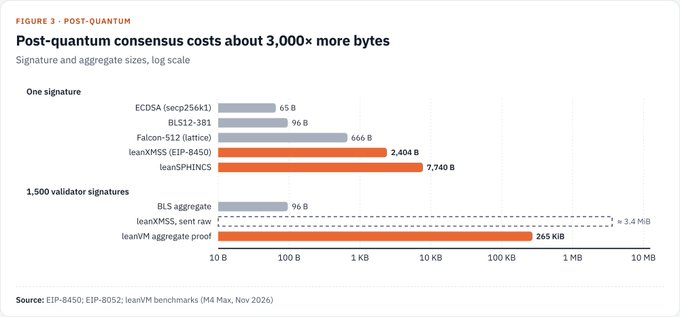
Quantum-resistant signatures present a separate size problem. The draft validator-key proposal EIP-8450 would register a dormant hash-based key alongside an existing key. The source gives a leanXMSS signature size of 2,404 bytes, versus 96 bytes for BLS. Because hash-based signatures cannot be combined in the same way as BLS signatures, the proposed design uses proofs that an aggregator checked them.
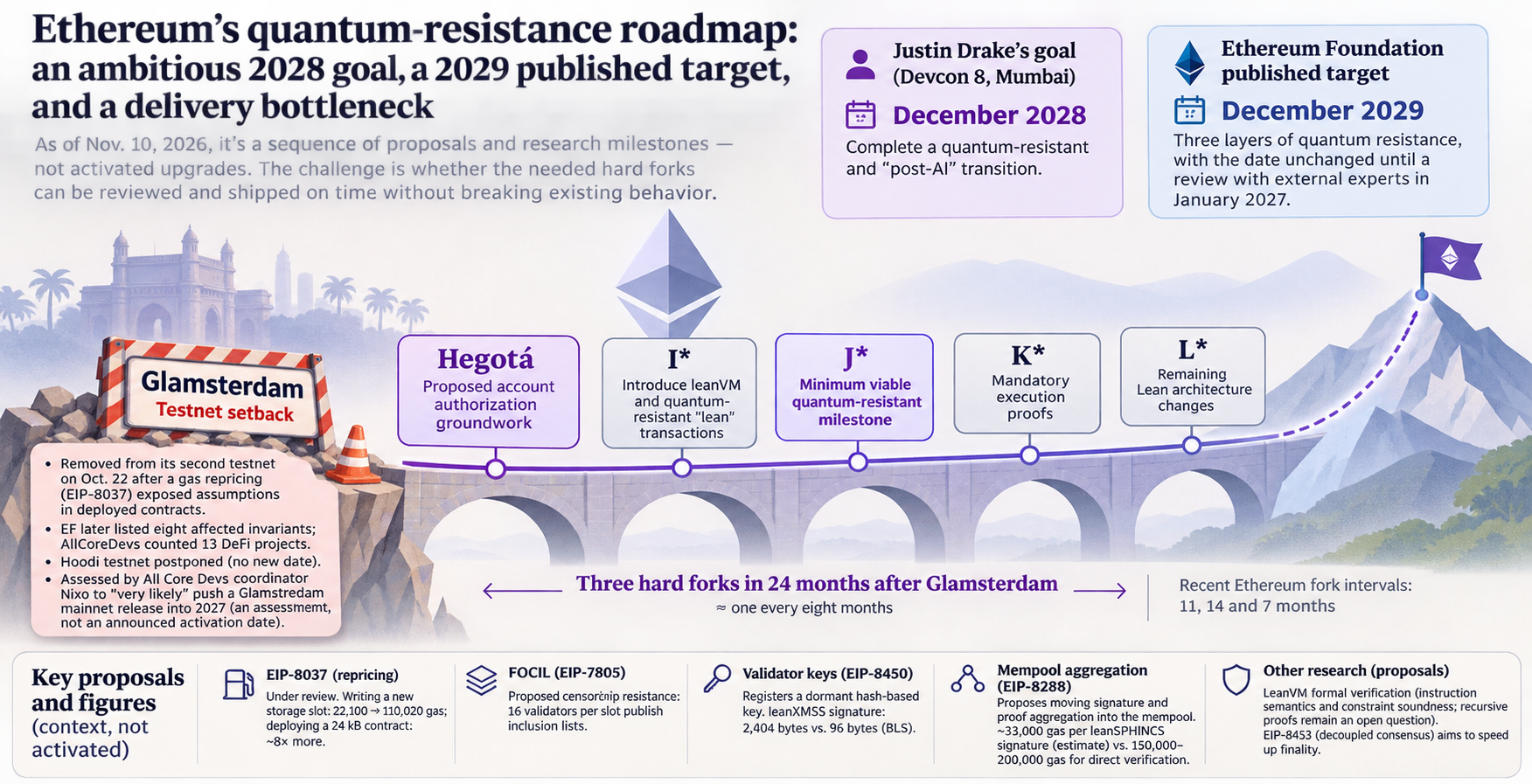
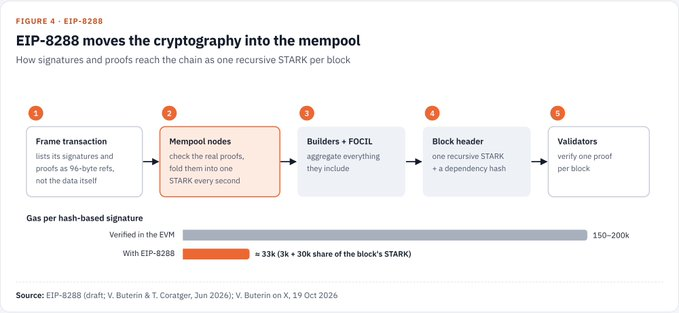
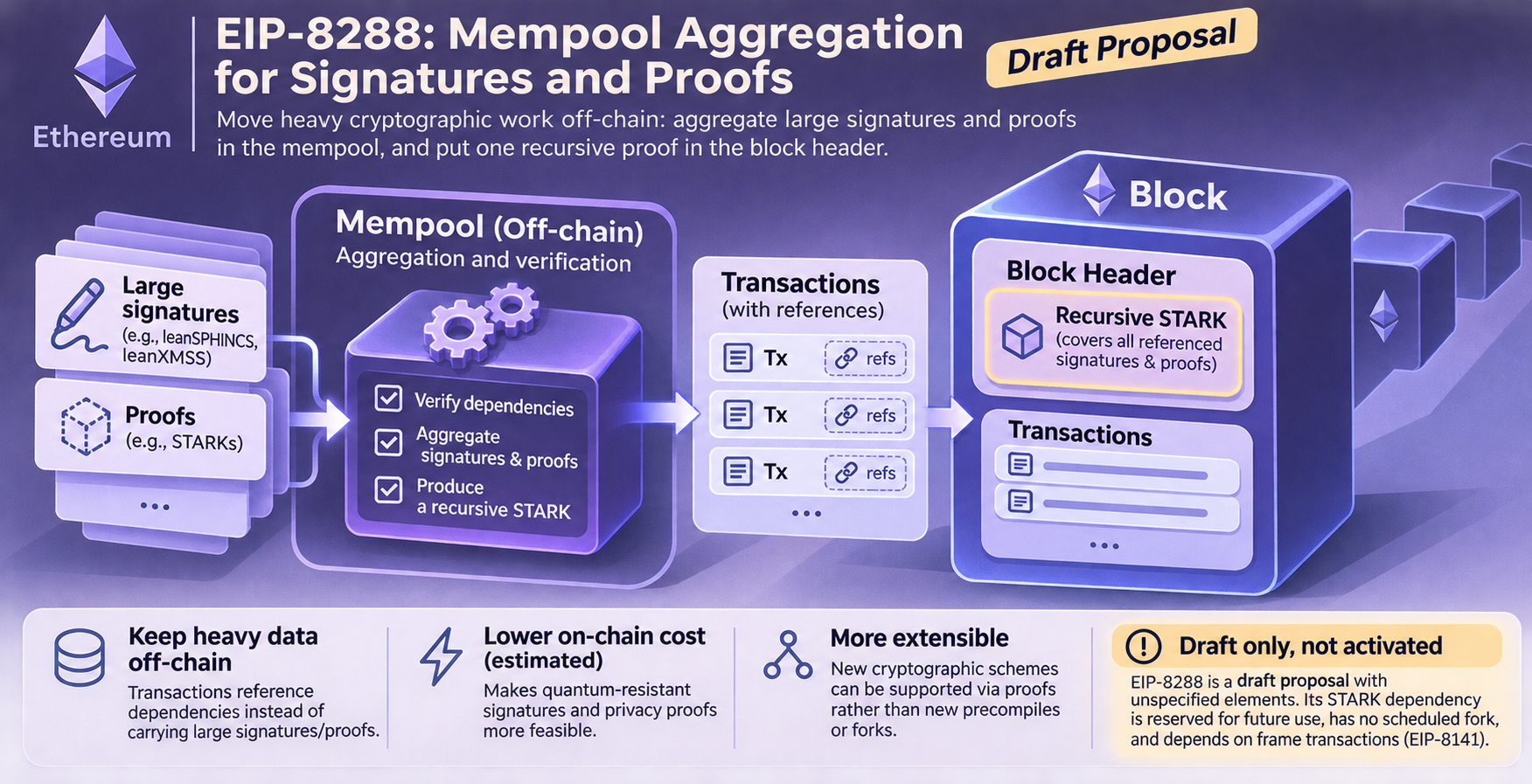
EIP-8288, a draft co-authored by Vitalik Buterin and Thomas Coratger, proposes moving signature and proof aggregation into the mempool. Transactions would declare references to large cryptographic dependencies rather than carry all that data on-chain; a recursive STARK in the block header would cover the dependencies. The source estimates about 33,000 gas per leanSPHINCS signature with this approach, versus 150,000–200,000 gas for direct verification. Those are estimates for a proposal, not current transaction costs. The draft still has unspecified elements, and its STARK dependency is only reserved for future use. It has no scheduled fork and depends on frame transactions.
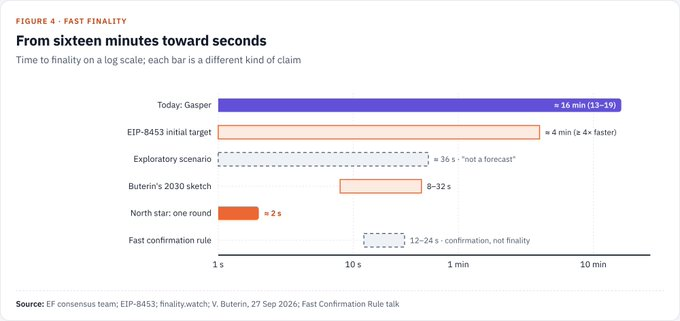
Other research remains at an earlier stage. Drake announced end-to-end formal verification of leanVM, but the source distinguishes the Lean 4 work on instruction semantics and constraint soundness from the Rust implementation’s differential testing; the soundness of recursive proofs remains an open question. A separate draft, EIP-8453, aims to speed up finality by separating fast chain confirmation from a finality component run by all validators. It, too, is a proposal rather than an activated consensus change.
The next decisions identified in the November 10 report were fixes for the Glamsterdam gas-repricing proposals and a new Hoodi date, followed by the January 2027 review of the Foundation’s quantum-resistance deadline. Until those dependencies and later fork contents are settled, December 2028 remains Drake’s stated goal—not Ethereum’s committed completion date.