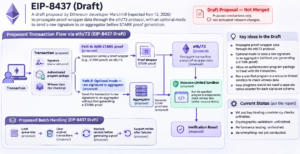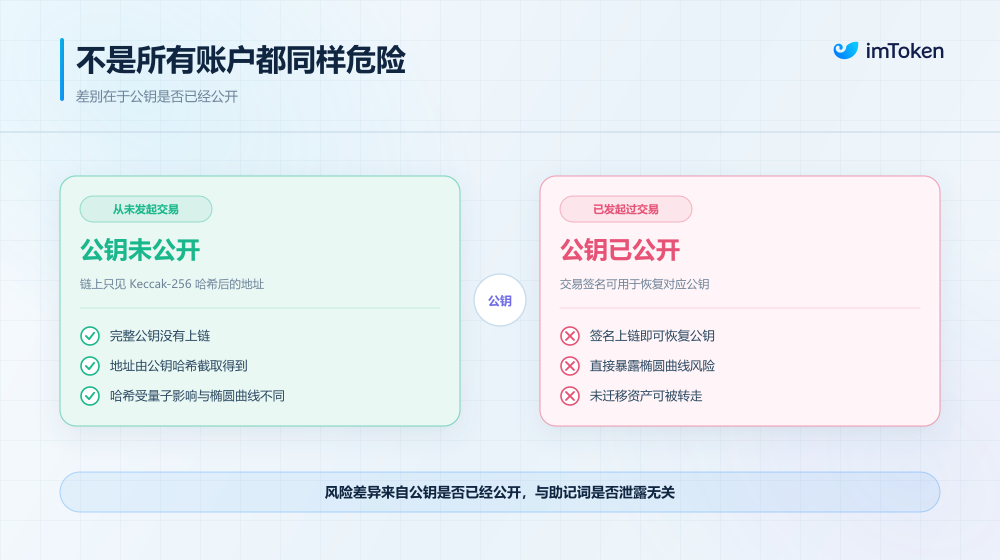
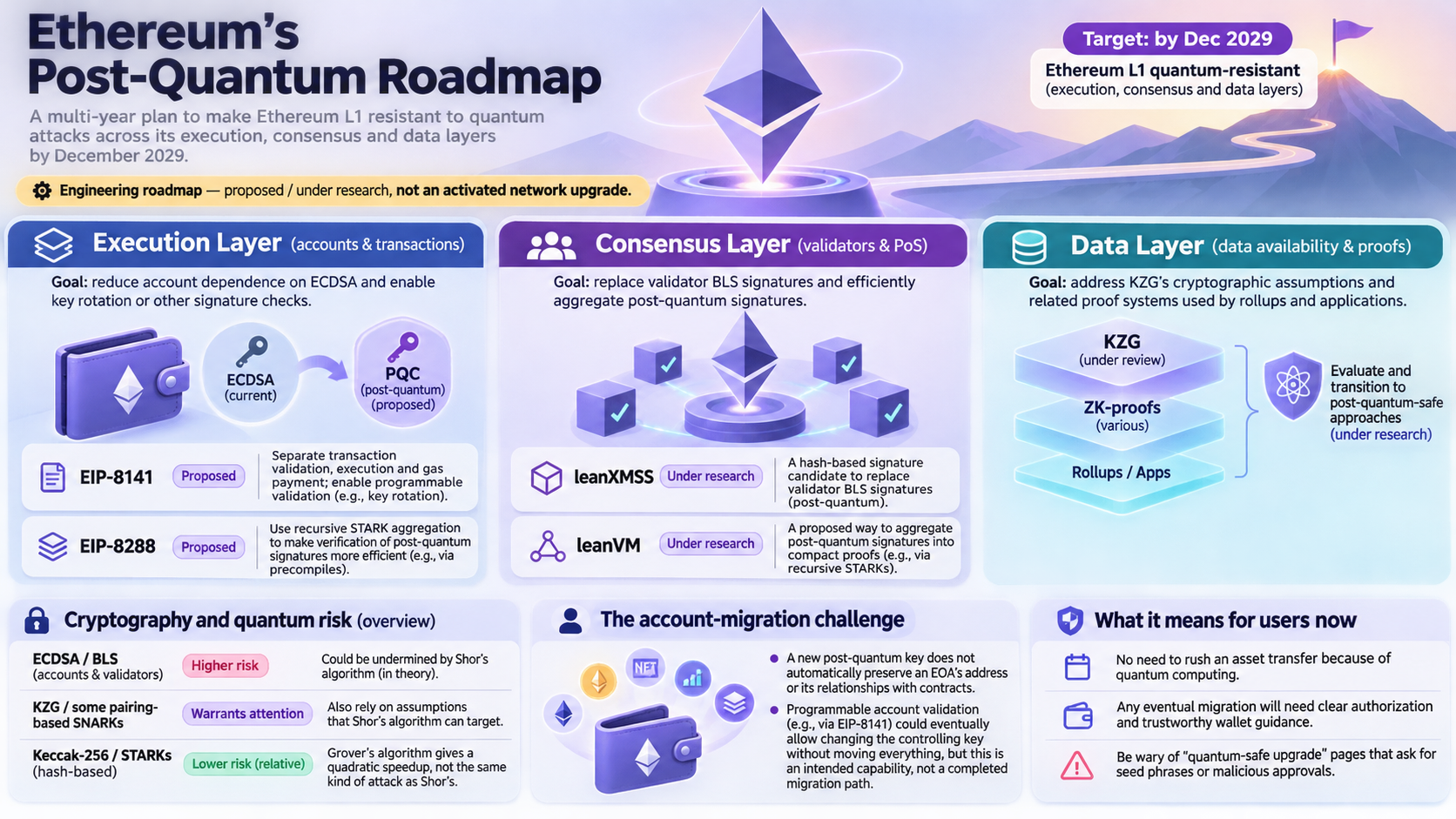
As reported on November 18, 2026, Ethereum’s post-quantum work was still an engineering roadmap, not an activated network upgrade. The account described a target, set out in September 2026 protocol priorities, of making Ethereum L1 resistant to quantum attacks across its execution, consensus and data layers by December 2029. Reaching that target would require more than replacing one signature algorithm: users would also need a safe way to retain control of existing accounts and assets.
Which parts of Ethereum face a quantum risk?
Ethereum uses different cryptographic tools for different jobs. Ordinary externally owned accounts (EOAs) use ECDSA signatures; proof-of-stake validators use BLS signatures, whose aggregation helps handle large numbers of votes. KZG commitments support blob and rollup data availability, while rollups and other applications use various zero-knowledge proof systems.
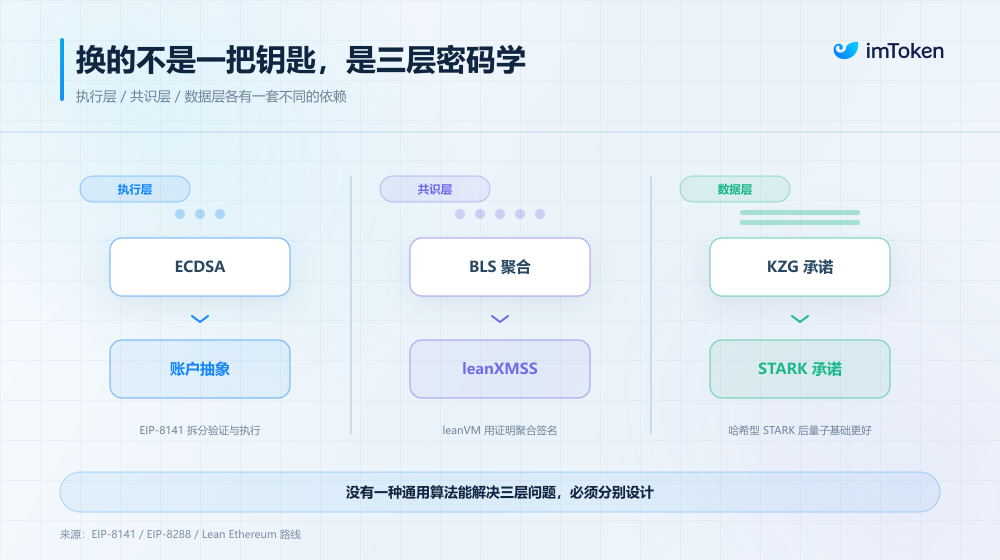
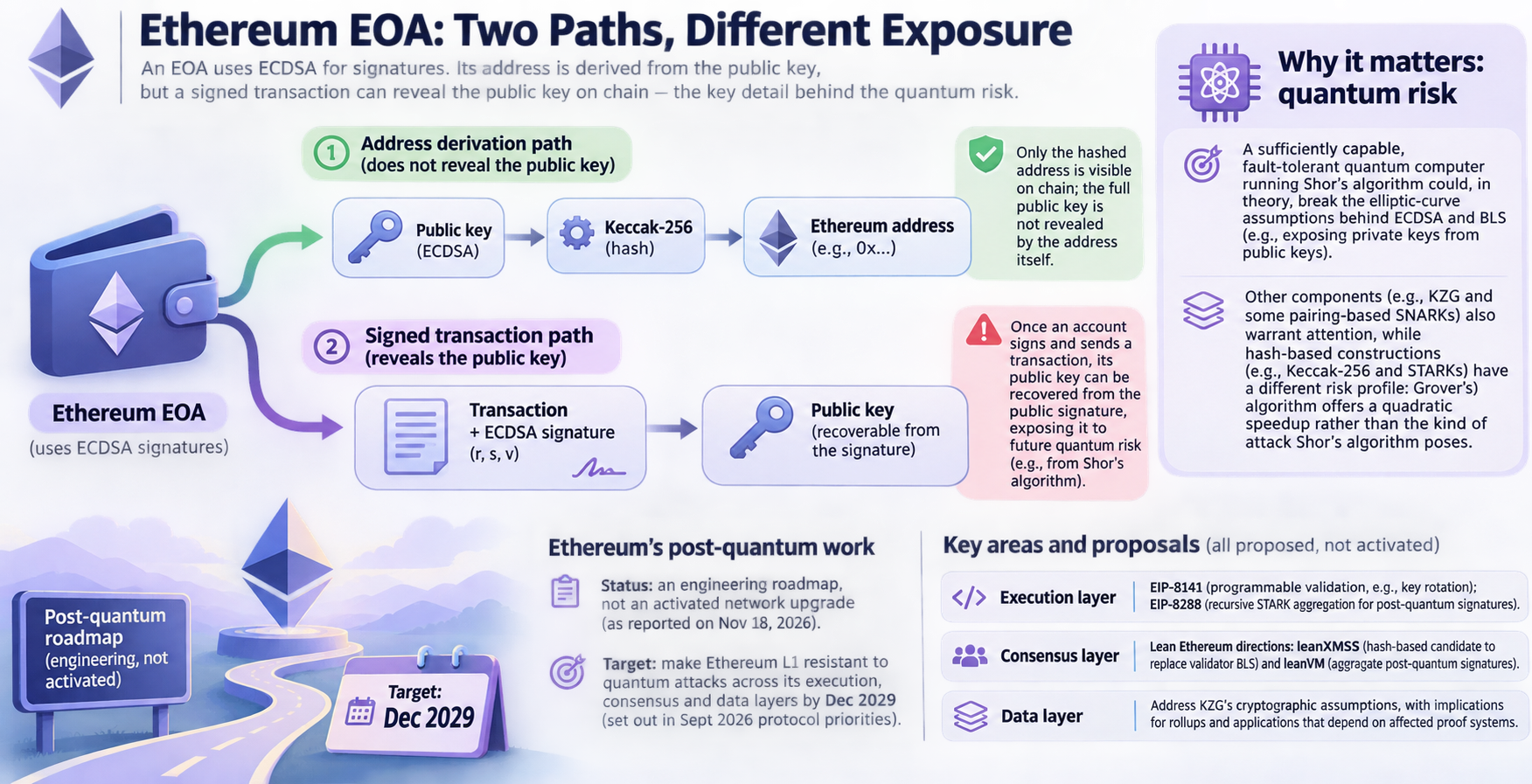
A sufficiently capable, fault-tolerant quantum computer running Shor’s algorithm could, in theory, undermine the elliptic-curve assumptions behind ECDSA and BLS. KZG and some pairing-based SNARKs also warrant attention. Hash-based constructions, including Keccak-256 and STARKs, have a different risk profile: Grover’s algorithm offers a quadratic speedup, rather than the kind of attack Shor’s algorithm poses to the cited elliptic-curve systems.
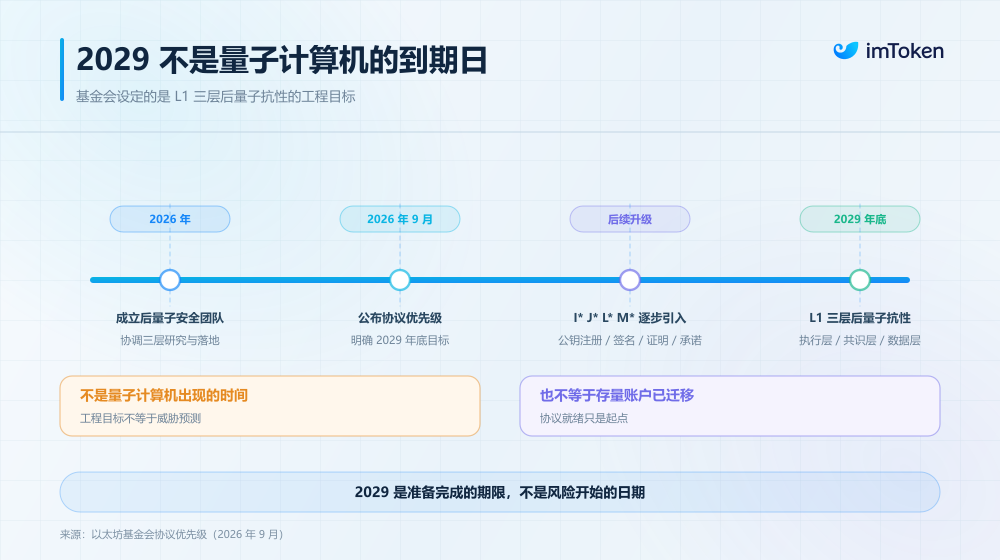
The distinction matters for EOAs. An address derived from a public key does not, by itself, reveal the full public key. Once an account signs and sends a transaction, however, its public key can be recovered from the public signature. The original account said no quantum computer then existed that could break these cryptographic systems in practice; the concern was the time a safe migration would take.
Proposals for accounts and validators
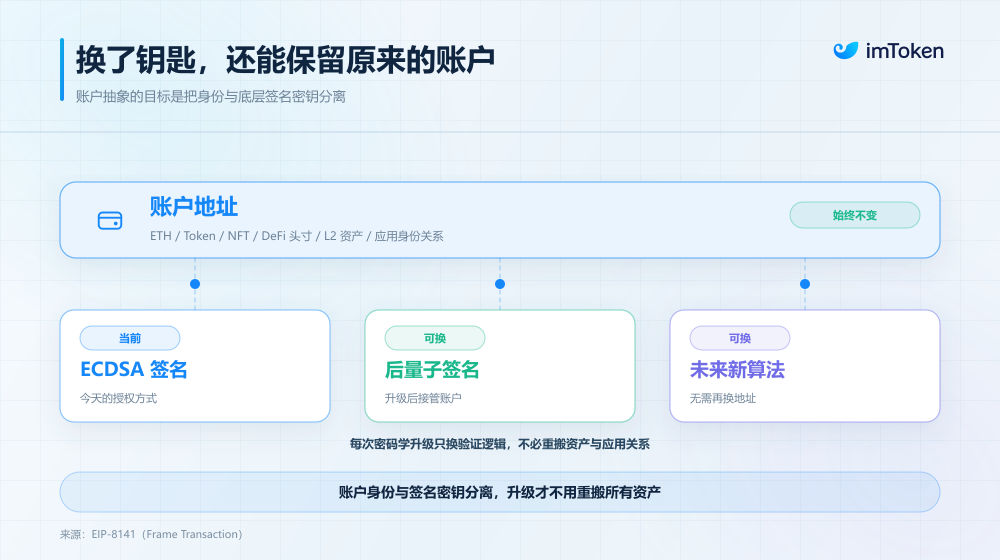
On the execution layer, the proposed EIP-8141 is presented as a way to separate transaction validation, execution and gas payment. Programmable validation could reduce an account’s permanent dependence on an ECDSA key and leave room for key rotation or other signature checks. That is a proposed capability, not a statement that existing EOAs can already change signature algorithms while keeping their addresses.
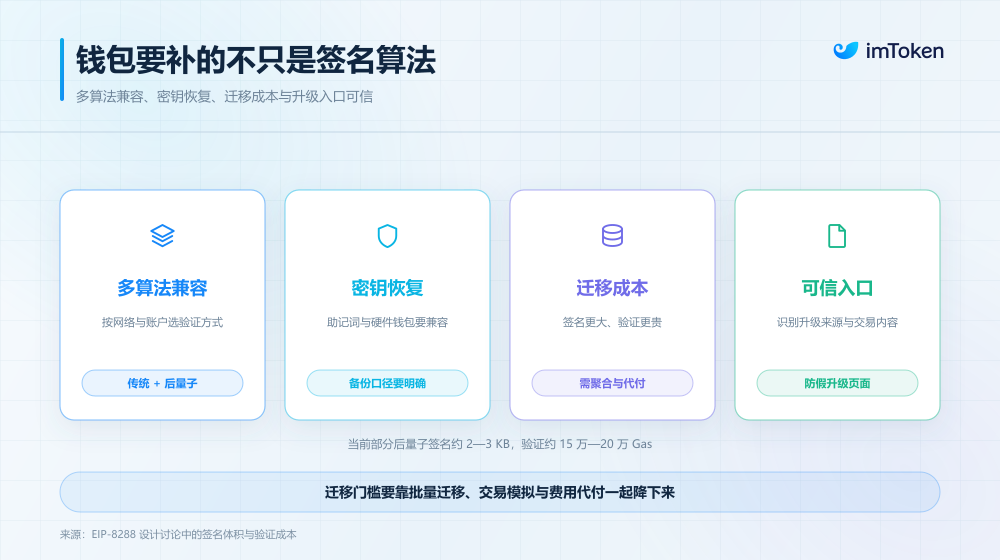
The account also described research into precompiles for verifying post-quantum signatures. Because such signatures can be much larger than ECDSA or BLS signatures, EIP-8288 proposes using recursive STARK aggregation to reduce the data and verification burden. Neither proposal was described as an activated upgrade.
For consensus, the Lean Ethereum directions discussed were leanXMSS, a hash-based candidate to replace validator BLS signatures, and leanVM, a proposed means of aggregating post-quantum signatures into compact proofs. A direct swap to larger signatures could increase peer-to-peer propagation, storage and verification costs. On the data layer, the reported roadmap also calls for addressing KZG’s cryptographic assumptions. These changes would have implications beyond L1 for rollups and applications that depend on affected proof systems.
The account-migration problem
A new post-quantum key does not automatically preserve an EOA’s address or its relationships with contracts. Moving to a new address could mean handling ETH, tokens, NFTs, DeFi positions, L2 assets and application-specific permissions or records. Programmable account validation could eventually offer a way to change the controlling key without moving everything, but the source presents that as an intended capability rather than a completed migration path.
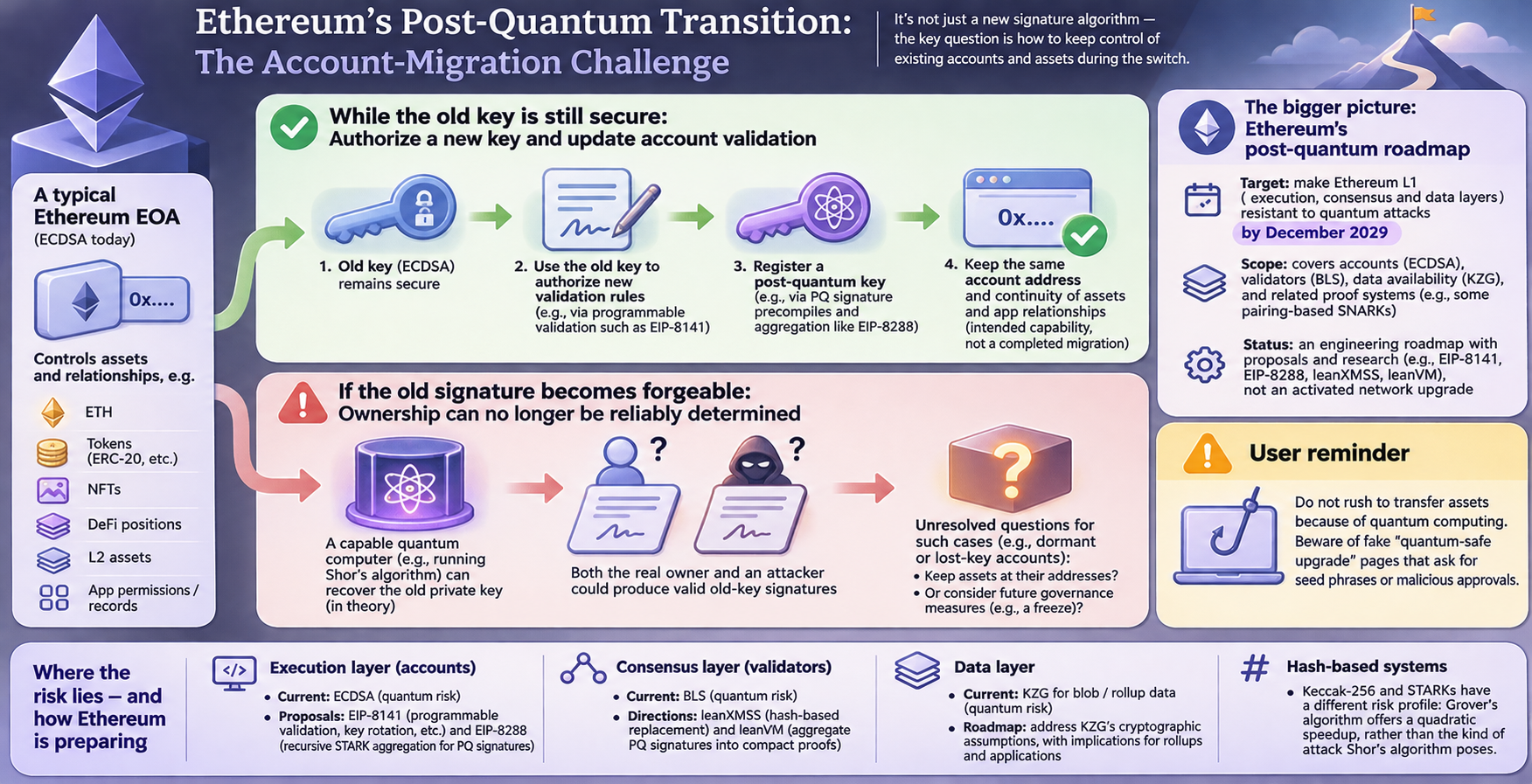
Timing is critical. While an old key remains secure, its owner could authorize a change to new validation rules. If that key becomes forgeable first, an old-key signature alone may no longer distinguish the owner from an attacker. The account also notes unresolved questions about dormant or lost-key accounts, including debate over whether assets should remain at their addresses or face future governance measures such as a freeze. No such measure is presented as an enacted rule.
For users, the reported position was not to rush an asset transfer because of quantum computing. Any eventual migration would need clear authorization and trustworthy wallet guidance; purported “quantum-safe upgrade” pages asking for seed phrases or malicious approvals would create a separate, immediate risk.