Historical report: Odaily published this account on November 9, 2026, at 09:54 (UTC+8), based on a post Vitalik Buterin made on X the previous evening. Odaily translated his remarks into Chinese.
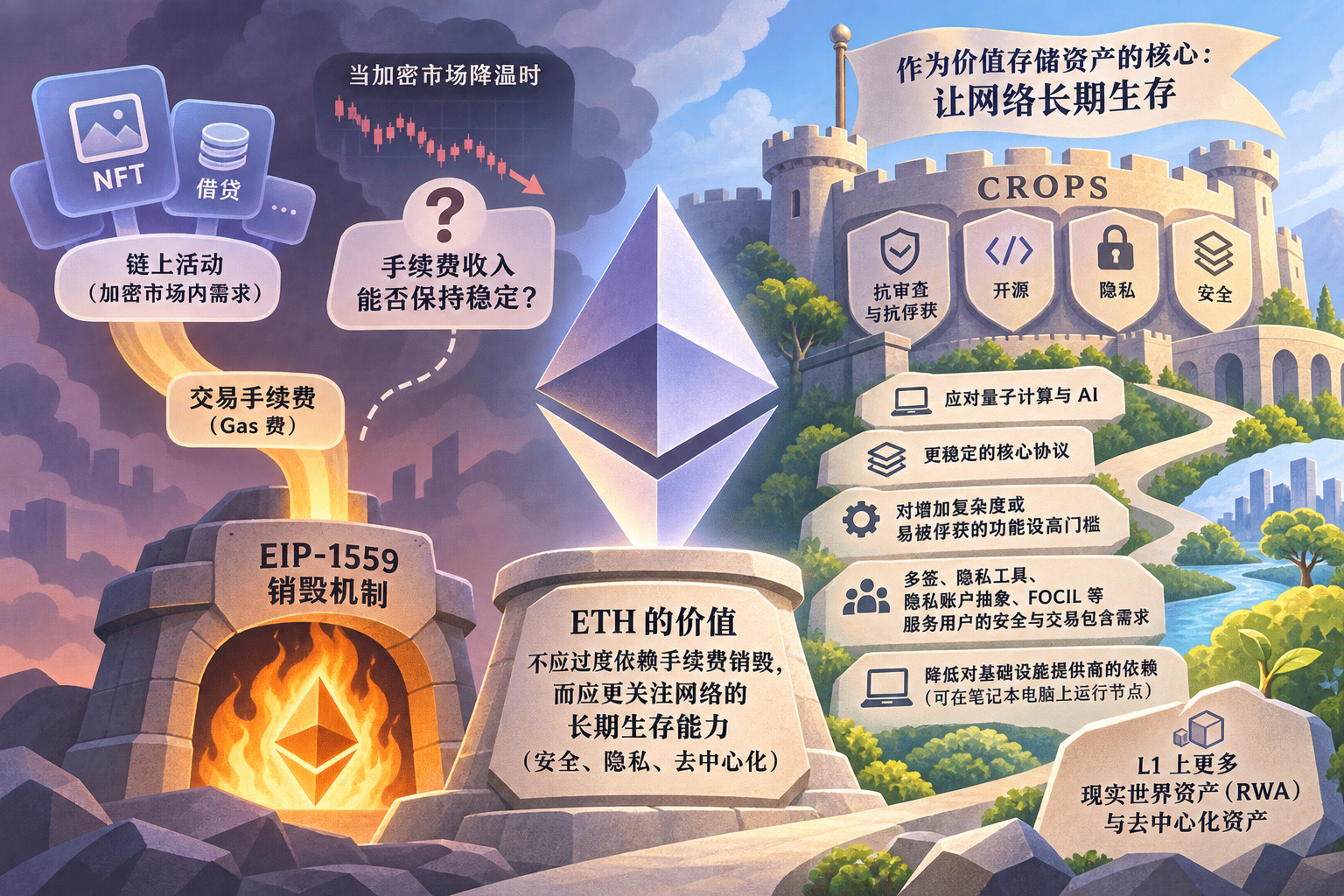
Vitalik Buterin argued that Ethereum should put less weight on transaction-fee burns as a basis for ETH’s value and more weight on the network’s ability to remain secure, private and decentralized over time. He did not call for removing EIP-1559 or its burn mechanism. In his view, even if long-term burns were less than 10% of new ETH issuance, that alone would not undermine ETH’s value proposition.
Why burns may not provide a valuation floor
Buterin described a simplified valuation model: annual fees burned divided by a discount rate. At $1 billion in sustained annual burns and a 4% discount rate, the model yields roughly $25 billion. Its weakness, he argued, is that fees generated by activity within the crypto market may fall when that market falls. He pointed to burns associated with NFT demand—including one day of approximately $180 million in fees—and lending activity during 2021–2023. Demand from outside crypto could make fee revenue more durable, he said, but established businesses are unlikely to reproduce the fees generated during speculative surges.
He also questioned what it would take to support ETH’s then-approximately $270 billion market capitalization primarily through burns. Comparing Ethereum hypothetically with a large company such as L’Oréal, he cited an AI-generated estimate that L’Oréal’s annual research-and-development spending equaled about 0.58% of its market value. Applying a comparable approach to Ethereum, he estimated, could require roughly 700,000 ETH a year in protocol funding and reduce validator income by about two-thirds. These were estimates within his hypothetical comparison, not proposed changes to Ethereum’s funding or validator rewards. He argued that large recurring allocations and more interventionist governance would create political and decentralization costs. Pursuing higher gas fees for their own sake could also exclude users who need the network’s privacy and security.
Resilience as a different priority
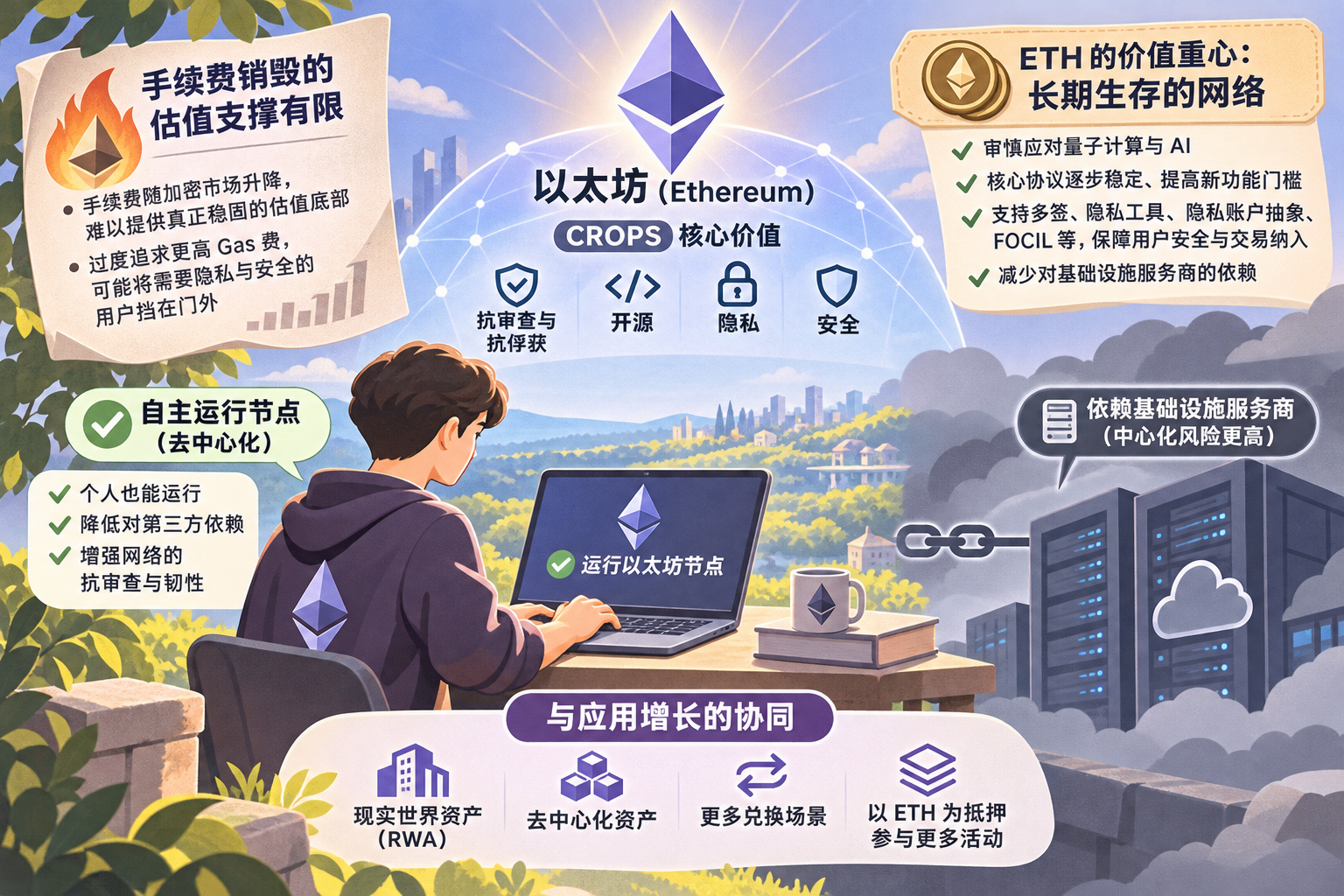
Buterin said people commonly value Ethereum for censorship and capture resistance, open source, privacy and security—qualities he grouped as CROPS. For someone holding ETH as a store of value, he argued, the central question is whether the network can survive over the long term.
That priority, in his account, calls for careful responses to quantum computing and AI, a progressively more stable core protocol, and a high bar for features that add complexity or create rewards vulnerable to capture. He cited multisignature wallets, privacy tools, private account abstraction and FOCIL as work serving users’ security and transaction-inclusion needs; the report does not establish any deployment status for those efforts. He also emphasized limiting dependence on infrastructure providers, saying he could run a node on a laptop, sync it in under six hours and use about one-eighth of its disk space—an improvement, in his comparison, over 2019.
Buterin saw potential compatibility between that approach and application growth: more real-world and decentralized assets issued on L1 could give ETH holders more ways to exchange assets or use ETH as collateral. He acknowledged trade-offs, including possible centralization pressure from shorter block intervals, but considered them less severe than optimizing chiefly for fee revenue.
Source: odaily.news (originally published 2026-11-09 09:54 UTC+8)